
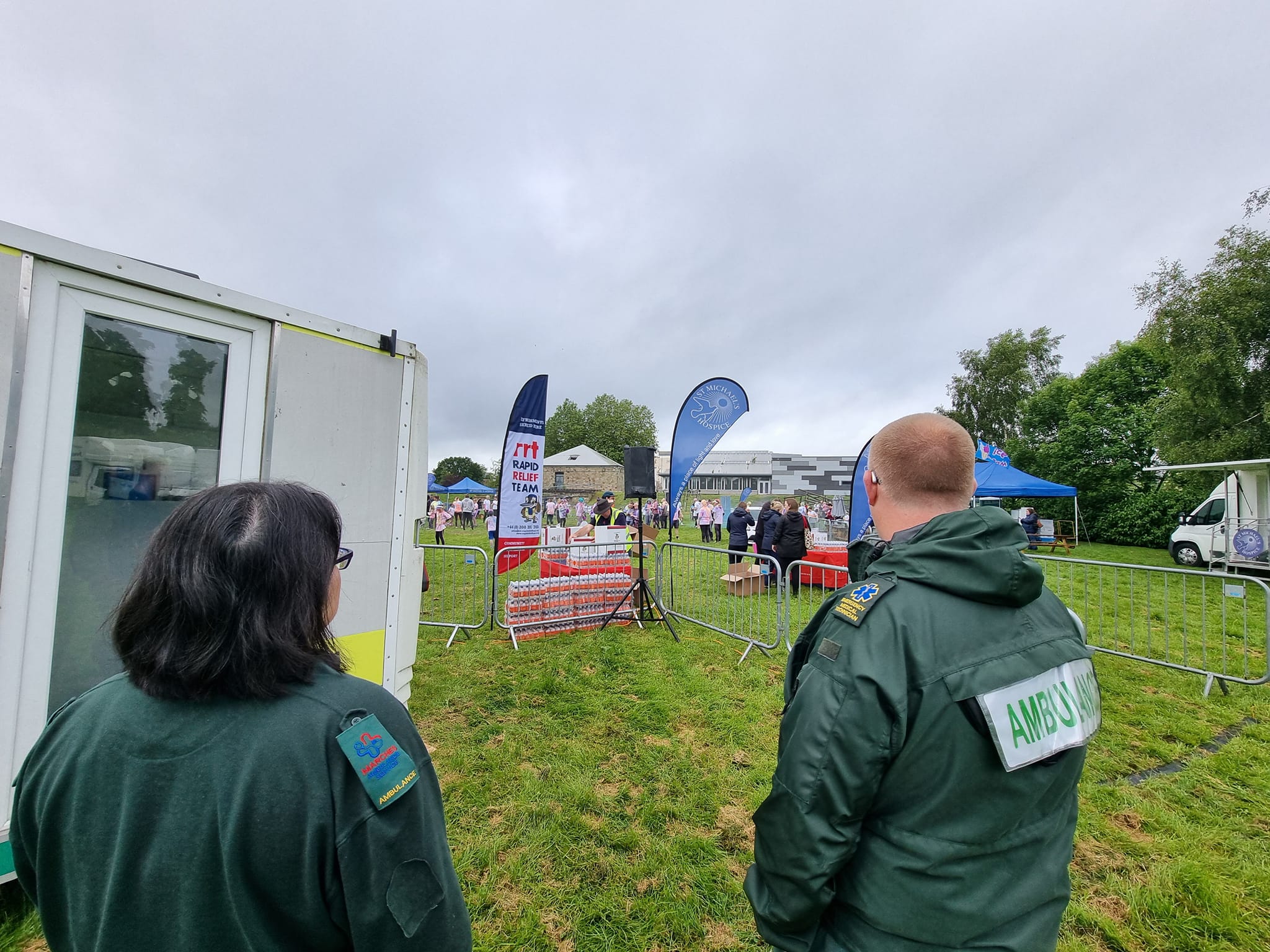
The Purple Guide 2026 Medical chapter provides important guidance for anyone organising a festival, agricultural show, concert, sporting event or other public gathering. Published in January 2026, it sets out how event organisers and medical providers should assess medical risks, determine suitable staffing, plan ambulance provision and manage healthcare throughout an event.
For organisers reviewing their event medical cover for 2027, the guidance offers a useful framework for deciding what medical provision is appropriate and how to evaluate potential suppliers.
But what do the Purple Guide 2026 medical changes actually mean in practice? Does every event need a paramedic? How many first responders might be appropriate? When should an ambulance be available?
At Marches Ambulance Service, we provide medical cover for festivals, shows, community events and sporting venues. We’re a CQC-registered independent ambulance service rated GOOD by the Care Quality Commission, with established experience at venues including Hereford FC and Ludlow Racecourse.
In this guide, we explain the January 2026 Medical chapter, its five tiers of event complexity and the practical considerations organisers should address when reviewing medical arrangements.
Planning medical cover for your next event?
Marches Ambulance Service can review your event requirements and discuss suitable first responder, clinical and ambulance provision.
What Is the Purple Guide?
The Purple Guide to Health, Safety and Welfare at Music and Other Events is published by the Events Industry Forum and provides recognised industry guidance for organisers, suppliers and others involved in event safety.
It covers a wide range of event planning considerations, including crowd management, welfare, emergency planning and healthcare.
The Medical chapter was updated in January 2026 and explains the principles that should inform medical provision at events.
The Purple Guide is not legislation. It describes good practice and should not automatically be treated as a mandatory staffing specification or a substitute for an individual event risk assessment.
Importantly, the guidance recognises that the medical requirements of a small community event will differ considerably from those of a large music festival or complex sporting event.
The appropriate level of cover must therefore be determined by the risks and characteristics of each event.
What Are the Key Purple Guide 2026 Medical Requirements?
The January 2026 chapter identifies several central principles that organisers should consider when planning event healthcare.
- Medical cover should be safe, effective and resilient.
- Events should minimise unnecessary impact on local NHS services.
- Medical provision should be based on a comprehensive Medical Needs Assessment.
- Attendance numbers should not be used as the sole basis for calculating resources.
- Organisers should undertake due diligence when appointing medical providers.
- Staff should hold suitable qualifications and have relevant experience.
- Medical staffing, equipment and facilities should reflect the event’s anticipated needs.
- Reliable communications, patient confidentiality and safeguarding arrangements are essential.
- Ambulance and hospital transfer arrangements should be planned in advance.
- Medical cover should consider the build, operational, ingress, egress and breakdown phases.
- Medical plans should make provision for unexpected contingencies and serious incidents.
These principles are not simply about providing more staff. They are about ensuring that the resources deployed are appropriate for the medical risks that may arise.
The Five Purple Guide Event Medical Complexity Tiers
One of the most useful parts of the January 2026 guidance is its framework of five tiers of event medical complexity.
These tiers help organisers and medical providers consider the likely level of medical provision needed at different events.
However, they are illustrative rather than prescriptive. An event does not automatically fall into a particular tier because of its attendance alone, and not every characteristic listed for a tier needs to apply.
These events are typically short, with minimal alcohol or drug use, low-risk activities and hospital referrals considered very unlikely.
The guide indicates that Tier 1 events can often be covered without a healthcare professional or ambulance in attendance. Organisers should nevertheless consider suitable first aid equipment, access to a defibrillator and arrangements for obtaining emergency assistance.
These may last longer than a few hours but usually no more than a day, with relatively low risks of illness or injury.
The guidance calls for a dedicated first aid resource, preferably led by a healthcare professional. Depending on the assessment, provision may include a nominated medical lead, supporting responders or clinicians, and an ambulance if hospital transfers are expected.
These events may extend beyond one day, involve moderate risks and have foreseeable hospital referrals. Alcohol or drug-related presentations may also be anticipated.
A dedicated medical resource would normally include a clinical lead with pre-hospital experience who is a registered healthcare professional, other healthcare professionals, first responders and ambulances where hospital transfers are expected.
These are larger or more complex events with significant potential for illness or injury, where hospital referrals are likely.
Provision should normally include a registered healthcare professional as clinical lead, an appropriate combination of doctors, nurses, paramedics and first responders, and ambulance resources with suitably qualified crews.
This tier includes mass gatherings and smaller events with particularly high risks. Serious presentations and hospital referrals are expected.
The guidance indicates that a comprehensive medical service should normally include a clinical lead who is a registered doctor, preferably an emergency medicine specialist, alongside registered healthcare professionals, first responders, ambulance crews and control staff.
These attendance figures are indicative characteristics, not automatic legal thresholds. A high-risk event with 1,000 people may require more substantial provision than a low-risk event with considerably greater attendance.
The final staffing and equipment requirements must follow a suitable Medical Needs Assessment.
Why Attendance Numbers Alone Are Not Enough
Historically, event organisers have sometimes sought medical quotations based mainly on anticipated crowd numbers.
However, the Purple Guide makes clear that attendance is only one factor affecting demand for medical assistance.
Relevant considerations include:
- Event type: A seated concert may present different risks from a high-energy music festival or competitive sporting event.
- Activities: Participant sports, physical challenges and higher-risk attractions can increase the likelihood of injury.
- Audience profile: Age, mobility, vulnerability and expected health needs can influence medical demand.
- Alcohol and substances: Intoxication may increase clinical, safeguarding and welfare requirements.
- Duration: Longer events can experience greater medical demand, particularly when attendance extends over several days.
- Weather: Heat, cold, humidity and severe conditions may influence illness and injury.
- Camping: Overnight attendance introduces additional medical and operational considerations.
- Site layout: Terrain, accessibility, distances, trip hazards and emergency vehicle access are relevant.
- Previous event history: Historical presentations and hospital referrals help inform future planning.
Two events with similar attendance figures may therefore require very different medical staffing arrangements.
For organisers, this means that a quotation based simply on a fixed number of first aiders per thousand attendees may not adequately demonstrate how the provider has assessed the event’s needs.
What Is a Medical Needs Assessment?
A Medical Needs Assessment (MNA) is the structured process used to identify the healthcare requirements and foreseeable medical risks associated with an event.
The Purple Guide states that prospective medical providers should prepare an event-specific assessment to determine the appropriate resources, which then informs the Medical Plan.
Its appendix recommends a stepwise approach.
1 Predict Expected Medical Presentations
Estimate how many people may require medical attention, using previous event records, comparable events and the characteristics of the proposed event.
2 Predict Medical Demand and Severity
Consider when medical demand may peak, what conditions may arise, and which presentations may require hospital assessment or ambulance transport.
3 Determine Appropriate Resources
Identify the staff, clinical skill mix, medical facilities, ambulances and other resources needed to manage predicted demand and reasonably foreseeable incidents, including peak periods.
The assessment should consider not only the average number of patients expected throughout the day, but also the periods when medical demand may be greatest.
Where staff are committed to specific roles, such as crowd patrols, athlete cover or remote medical posts, those responsibilities must be reflected in overall resource calculations.
The Medical Needs Assessment should remain under review when the event’s arrangements or risks change.
What Should Be Included in an Event Medical Plan?
The Medical Needs Assessment establishes what resources are appropriate. The Medical Plan explains how those resources will be organised and delivered.
The January 2026 chapter identifies a range of information that would normally be included in the plan.
- Details of the medical provider and named responsible individuals.
- Event type, audience profile, activities and relevant historical information.
- Agreed periods of medical cover.
- Site locations, access routes and medical responsibilities.
- Numbers, qualifications and deployment locations of medical staff.
- Medical facilities, vehicles and available equipment.
- Communications, command and control arrangements.
- Patient records and information-sharing arrangements.
- Safeguarding and infection prevention procedures.
- Relevant camping and overnight medical arrangements.
- Major incident and contingency procedures.
- Known hazards and associated risk mitigation.
The plan should also make clear how medical assistance is requested, how patients are moved around the site, and what happens when hospital treatment is needed.
For larger events, appropriate engagement with the Safety Advisory Group, NHS ambulance service and other relevant agencies may form part of the planning process.
What Qualifications Should Event Medical Staff Have?
The Purple Guide emphasises that medical staff should have qualifications, competence and experience suitable for their role.
It recommends using the Faculty of Pre-Hospital Care’s pre-hospital emergency medicine competency framework to help understand staff capabilities.
The framework described in the chapter runs from Level A through to Level H.
Level D
Secondary responder. Examples include FREC 3 and comparable recognised responder qualifications.
Level E
Pre-hospital provider. Examples include FREC 4 and recognised advanced first aid qualifications.
Level F
Non-registered healthcare professional. Examples include certain ambulance technician qualifications.
Level G
Registered pre-hospital healthcare professional. Examples include HCPC-registered paramedics and appropriately experienced nurses and doctors.
Level H
Advanced pre-hospital healthcare professional. Examples include suitably qualified advanced practitioners and specialist doctors.
The 2026 chapter recommends Level D as the minimum qualification for staff working unsupervised at licensed events.
It also states that lower-level qualifications are generally not considered suitable for licensed events except as part of a larger team under direct supervision, although they may be appropriate for some Tier 1 events.
This is a recommendation within the guidance, not a statutory rule applying identically to every event.
Why Job Titles Can Be Misleading
Terms such as first responder, medical responder and medic are not equivalent to protected professional registration.
In contrast, the titles paramedic, registered nurse and doctor have defined professional registration requirements.
Organisers should therefore ask what qualifications and competencies staff actually hold, rather than relying on job titles alone.
Professional registration can be checked through the relevant registers, including the HCPC, NMC and GMC.
Why Staffing Levels and Skill Mix Matter
The Purple Guide recognises that the capability of a medical team can affect how patients are treated and whether onward referral is necessary.
A team with an appropriate combination of registered healthcare professionals and trained responders may be able to assess and manage a wider range of presentations on site.
However, adding a paramedic or doctor should not be treated as a universal requirement for every event. The clinical skill mix should match the expected and reasonably foreseeable medical needs.
The chapter also advises against double-hatting, where staff are counted as providing dedicated medical cover while simultaneously carrying out unrelated duties.
For example, stewards or security staff who hold first aid qualifications should not automatically be counted as dedicated medical resources if they are already committed to their primary role.
The organiser and provider should agree staffing numbers, qualifications and responsibilities as part of the Medical Plan.
What Does the Purple Guide Say About Ambulances?
Ambulance provision should be considered whenever the event’s foreseeable medical presentations may require transport to hospital or another healthcare facility.
However, the guidance does not impose a universal rule that every event must have an ambulance on site.
The Medical Needs Assessment should determine whether ambulances are required, how many are appropriate and what qualifications the crews should hold.
Hospital Transfers Must Not Leave the Event Exposed
An important principle in the 2026 chapter is that transporting a patient away from an event should not compromise the medical provision remaining on site.
For example, an event relying on a single ambulance for both its on-site medical cover and hospital transfers may need a contingency arrangement if that ambulance leaves.
Options may include additional ambulance resources or a separately commissioned transport arrangement, depending on the event’s risks and predicted demand.
Should Events Rely on 999 Ambulances?
The Purple Guide encourages organisers to minimise unnecessary reliance on NHS ambulance services.
It recommends appropriate arrangements for patients who need hospital assessment, recognising that some may require an ambulance while others can use suitable non-urgent transport.
The NHS emergency ambulance service remains essential for emergency assistance and should be contacted when necessary for patient safety.
Organisers should not treat routine use of 999 as a substitute for adequate medical planning, nor should they delay an emergency call where one is needed.
What About Ambulance Regulation?
In England, some patient transport activities are regulated by the Care Quality Commission.
The January 2026 Purple Guide chapter was written against the regulatory position at that time, when certain event-site treatment activities benefited from exceptions to CQC registration.
Separate legislative changes are now bringing certain Treatment of Disease, Disorder or Injury activities at events within CQC regulation from 6 December 2027.
Organisers should therefore consider the provider’s registration for the particular healthcare and transport services being commissioned.
For a detailed explanation, read our guide to how event medical providers are regulated and our 2027 event healthcare regulation update.
Does your event need an ambulance or paramedic team?
We can assess the medical requirements of your festival, agricultural show, sporting fixture or public event and recommend proportionate resources.
Medical Facilities, Equipment and Site Access
Suitable medical facilities should reflect the size, duration and medical needs of the event.
For smaller events, an appropriate first aid location may be sufficient. Larger events may require dedicated medical treatment facilities with space for multiple patients and appropriate clinical resources.
The Purple Guide identifies considerations including:
- Safe, accessible and appropriately located treatment areas.
- Privacy for patients receiving assessment and treatment.
- Lighting, heating, ventilation or cooling as appropriate.
- Running water and suitable hygiene arrangements.
- Electricity for clinical equipment.
- Cleanable surfaces and suitable waste disposal.
- Toilets and welfare facilities.
- Clear signage and access for ambulances and stretchers.
Site access should also allow medical teams to reach patients efficiently without creating additional risks to the public.
For crowded areas, foot patrols or suitable smaller response vehicles may be more appropriate than moving a conventional ambulance through dense crowds.
Medical Communications and Patient Confidentiality
Reliable communication is a fundamental part of effective event healthcare.
The January 2026 guidance recommends a dedicated medical radio channel where radio communications are used.
It also advises that medical dispatch communications should normally be kept separate from general event radio traffic, partly because of confidentiality and data protection considerations.
Organisers should ensure that stewards, marshals, volunteers and security personnel know how to request medical assistance.
For larger events, a medical representative may need to be included in Event Control, with suitable arrangements for dispatch, operational logging and coordination.
Who Can Access Patient Records?
Medical records contain confidential personal information.
The Purple Guide makes clear that event organisers do not automatically have access to identifiable patient records simply because they commissioned the medical service.
Records may be shared where an appropriate legal basis exists, including valid consent, established information-sharing arrangements or applicable statutory duties.
Organisers should instead expect appropriate anonymised activity reporting, subject to the relevant data protection requirements.
Safeguarding, Mental Health and Welfare
Medical services should consider more than physical injury.
Events can involve mental health crises, intoxication, vulnerable adults, children and people requiring additional support.
The Purple Guide encourages effective alignment between medical and welfare services, including safeguarding procedures and suitable referral or escalation arrangements.
Depending on the nature of the event, medical providers may need to coordinate closely with security, welfare services, safeguarding leads and statutory services.
Organisers should understand who has responsibility for these functions and ensure that medical staff are appropriately trained and supported.
Medical Cover Before, During and After the Event
Another important aspect of the guidance is the need to consider medical cover throughout the event lifecycle.
Build and Preparation
Large events can involve substantial numbers of contractors working on site before the public arrives.
Organisers should ensure that first aid and any additional medical arrangements for the build phase are addressed, including the responsibilities of individual contractors.
Operational Hours
The main event medical provision should be available during the agreed operating periods, with resources deployed appropriately across the site.
At larger events, full staffing may be introduced in stages to reflect changes in activity and attendance.
Audience Egress
Medical risks do not necessarily end when the final performance finishes or the venue closes.
Audience departures, transport queues, camping areas and crowd movement may continue to generate medical demand.
The Medical Plan should specify appropriate post-event cover and arrangements for final stand-down.
Breakdown
Site breakdown may involve vehicle movements, dismantling structures, equipment handling and other workplace risks.
Where appropriate, separate first aid or medical provision should be considered for this period.
Planning for Major and Critical Incidents
The January 2026 Medical chapter emphasises the importance of resilience and contingency arrangements.
Medical plans should not address only the most likely minor injuries and illnesses. They should also consider how teams will respond to serious but reasonably foreseeable situations.
The chapter includes recommendations relating to major incident preparedness, initial lifesaving interventions and Ten Second Triage.
It distinguishes a major incident declared by statutory emergency services from situations in which a medical provider may declare a critical incident because available resources are insufficient.
At larger or more complex events, organisers should establish:
- Clear arrangements for medical command and escalation.
- Communication with Event Control and statutory emergency services.
- Initial response capabilities for serious incidents.
- Methods for requesting additional resources.
- Evacuation and casualty movement arrangements.
- How medical cover will be maintained elsewhere on site during an incident.
These arrangements should be proportionate to the event and integrated with the wider emergency plan.
Choosing an Event Medical Provider: What Should Organisers Check?
The Purple Guide places importance on due diligence when selecting a medical provider.
Organisers should be satisfied that a company has the appropriate experience, staffing, leadership and resources to deliver its proposed service.
✓ Relevant Event Experience
Has the provider delivered comparable events, venues or multi-day operations?
✓ Appropriate Staffing
Can it demonstrate suitable qualifications, experience and competency checks?
✓ Clinical Leadership
Is there a clearly identified person responsible for medical service delivery and escalation?
✓ Medical Planning
Will the provider prepare a suitable Medical Needs Assessment and Medical Plan?
✓ Clinical Governance
Are medicines, patient records, safeguarding, infection prevention and clinical incidents appropriately managed?
✓ Vehicles and Equipment
Are ambulances and medical resources fit for purpose, suitably equipped and operated by appropriate personnel?
✓ Insurance and Regulation
Does the provider have appropriate insurance and any CQC registration required for the commissioned services?
✓ Contingency Arrangements
How will the provider manage hospital transfers, serious incidents and unexpected demand?
The chapter also recommends obtaining references where appropriate and establishing clear accountability when multiple medical organisations are involved.
What Should Organisers Receive After an Event?
The Purple Guide recommends obtaining a post-event report from the medical provider.
This should provide useful information for reviewing performance and planning future events, including:
- A summary of the medical service delivered.
- Resources and capabilities deployed.
- Numbers and types of patient presentations.
- Relevant medical interventions and hospital referrals.
- Operational issues or gaps identified.
- Recommendations and learning for future events.
For recurring festivals, agricultural shows and sporting venues, this information can be particularly valuable in refining the next event’s Medical Needs Assessment.
It also gives organisers a better evidence base when reviewing staffing and financial arrangements for future contracts.
How Does the Purple Guide 2026 Relate to the New CQC Rules for 2027?
The Purple Guide and CQC registration rules serve different purposes.
The Purple Guide provides industry guidance on how to assess risks and plan medical provision.
CQC regulation determines whether a provider delivering specified regulated healthcare activities in England must be registered and meet the applicable regulatory requirements.
Following amendments to the regulations, certain Treatment of Disease, Disorder or Injury services delivered at events will come fully within CQC regulation from 6 December 2027.
Providers have been able to apply for registration or update their existing registration details since 7 September 2026, with 1 March 2027 an important application milestone.
These changes do not automatically mean that every event needs a paramedic, ambulance or CQC-registered healthcare service. The precise requirements depend on the services being delivered and the event’s assessed needs.
Organisers should check both the medical suitability of the proposed service and the regulatory position of the organisation delivering it.
Read our Event Healthcare Standard and CQC Changes for 2027 article for further information.
How Marches Ambulance Service Supports Event Organisers
Marches Ambulance Service provides medical services for event organisers, sporting venues, festivals and public events.
We’re a CQC-registered independent ambulance service rated GOOD, with clinically led services and established governance arrangements.
Our experience includes more than six seasons providing crowd and player medical cover at Hereford FC and three seasons supporting racecourse medical provision at Ludlow.
Depending on an event’s assessed needs, we can provide:
- First responders and trained ambulance professionals.
- Registered paramedics and other healthcare professionals.
- Ambulances and rapid response vehicles.
- Medical facilities and treatment areas.
- Medical leadership and operational coordination.
- Medical planning and appropriate clinical governance.
Our approach is to recommend proportionate medical provision based on the event’s risks rather than simply increasing staffing because an event has grown in size.
For venues and organisers managing multiple events throughout the year, we can also discuss ongoing arrangements that support consistent planning, staffing and service delivery.
Reviewing medical cover for your 2027 events?
Whether you manage a one-day agricultural show, a multi-day festival or a sporting venue with regular fixtures, Marches Ambulance Service would welcome the opportunity to discuss your requirements.
Call 01568 605110
Frequently Asked Questions About the Purple Guide 2026
Is the Purple Guide a legal requirement?
No. The Purple Guide is recognised industry guidance rather than legislation. However, it provides an important framework for considering what appropriate event healthcare arrangements may look like.
How many first aiders do I need for 1,000 people?
There is no universal staffing number determined solely by attendance. The appropriate provision depends on the event type, activities, duration, audience, site and foreseeable medical requirements. A Medical Needs Assessment should inform the recommendation.
Does a Tier 2 event need a paramedic?
Not automatically. The guidance recommends dedicated first aid provision, preferably led by a healthcare professional, with additional clinical resources determined by the event’s medical needs.
Does a Tier 3 event need an ambulance?
Tier 3 provision would normally include a dedicated medical resource with an appropriately qualified clinical lead and other medical staff. Ambulances with suitable crews should be included where hospital transfers are expected.
What is the recommended minimum qualification for medical staff?
The January 2026 chapter recommends a nationally recognised PHEM Level D pre-hospital qualification for staff working unsupervised at licensed events. The appropriate level of staffing still depends on the event’s needs and the roles being performed.
Can security staff who are first aiders count towards medical staffing?
The guidance advises against double-hatting. Staff undertaking primary stewarding or security duties should not automatically be counted as dedicated medical resources while performing those duties.
Do all events need a Medical Needs Assessment?
The guide recommends proportionate medical planning for every event. A simple, low-risk event may require a relatively straightforward assessment, while a larger or complex event will need more detailed consideration and a suitable Medical Plan.
Do organisers have to provide an ambulance?
No universal requirement applies to every event. Ambulance provision depends on the assessed risks, likely hospital transfers, site conditions and the need to maintain adequate medical cover when a patient leaves the site.
Should events use 999 ambulances for hospital transfers?
Emergency ambulance services should be called when needed for patient safety, but organisers should not rely on routine 999 use instead of appropriate event medical and transport planning.
Does the Purple Guide 2026 require CQC registration?
The Purple Guide does not itself create CQC registration requirements. Separate legislation determines which healthcare and transport activities require registration. New rules relating to certain event-site clinical treatment take full effect in December 2027.
Plan Your Event Medical Cover With Confidence
The January 2026 Purple Guide Medical chapter reinforces a practical principle: medical cover should reflect the real risks of the event and the capabilities required to manage them.
For organisers, that means understanding the five tiers of complexity, commissioning a suitable Medical Needs Assessment, checking provider competence and establishing appropriate arrangements for staffing, clinical care, ambulances, communications and contingencies.
Marches Ambulance Service supports organisers looking for appropriately planned medical provision, whether for a small community event, a large festival or a programme of sporting fixtures.
Let’s Discuss Your Event Medical Requirements
Tell us about your event, expected attendance, location and activities. We can review the requirements and discuss an appropriate medical cover proposal.
Official Sources and Further Reading
- The Purple Guide — Medical Chapter, January 2026
- CQC — Treatment of Disease, Disorder or Injury at Events
- Event Healthcare Regulation and Changes for 2027
- How Are Event Medical Providers Regulated?
- Marches Ambulance Service — Event Medical Cover
Reviewed: November 2026. This article summarises the January 2026 Purple Guide Medical chapter and provides general information for event organisers. The Purple Guide is industry guidance, not legislation. Regulatory requirements differ across the UK and should be checked against current official guidance.