
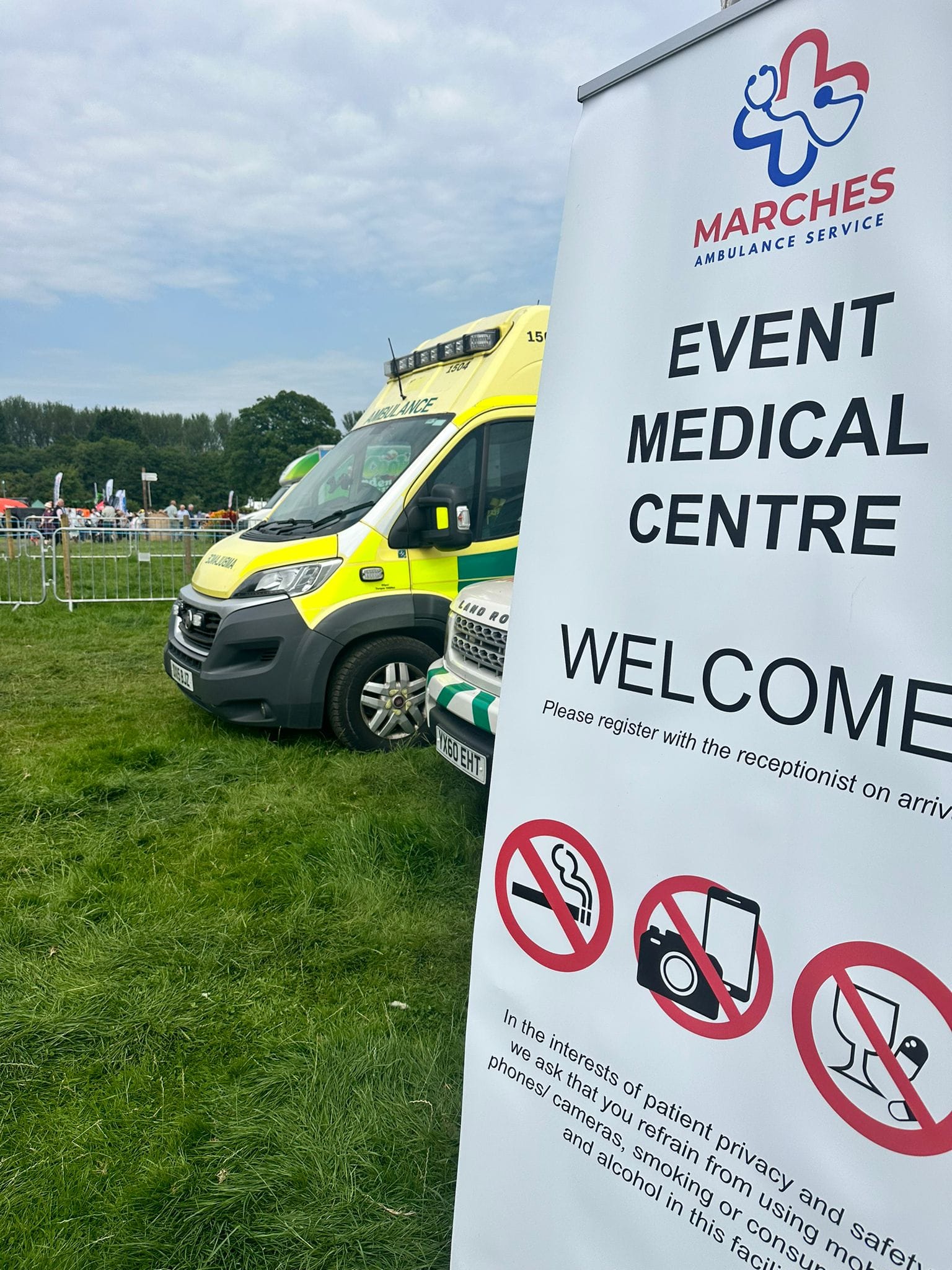
How are event medical providers regulated in the UK, and how can event organisers be confident they are appointing a safe, appropriately qualified and accountable provider?
Whether you’re organising a music festival, agricultural show, sporting event, Christmas market or large public gathering, choosing the right medical provider involves much more than checking that an ambulance or first aid team is available.
Event organisers need to understand who is responsible for patient care, whether the provider requires Care Quality Commission (CQC) registration, what qualifications its staff hold and how clinical decisions are governed.
The regulatory framework is changing following amendments to the rules covering healthcare at sporting and cultural events in England, with important requirements taking full effect from 6 December 2027.
This guide explains the difference between CQC registration, professional regulation, first aid qualifications, clinical governance and event medical planning. It also provides a practical checklist for organisers selecting a provider.
Marches Ambulance Service is CQC registered and rated GOOD, with experience supporting festivals, agricultural shows, community events and sporting venues.
Who Regulates Event Medical Providers in the UK?
There is no single organisation responsible for every aspect of event medical provision.
Different regulatory bodies and legal requirements apply depending on the healthcare activities being provided, the professionals delivering them and the location of the event.
In England, the principal areas to understand are:
- Care Quality Commission (CQC): Regulates providers carrying on specified regulated activities, including Treatment of Disease, Disorder or Injury where the legal criteria are met.
- Health and Care Professions Council (HCPC): Regulates paramedics and other specified healthcare professionals.
- Nursing and Midwifery Council (NMC): Regulates registered nurses and midwives.
- General Medical Council (GMC): Regulates doctors.
- Health and safety law: Places relevant duties on employers, organisers and contractors to manage risks.
- Industry guidance: Including the Purple Guide and, for applicable sports grounds, the Green Guide, supports proportionate event medical planning.
These responsibilities are complementary. A clinician being professionally registered does not automatically mean the organisation providing their services is appropriately registered with CQC.
Equally, a company being CQC registered does not remove the need to check the competence, training and scope of practice of its staff.
What Does CQC Registration Mean for Event Medical Cover?
The Care Quality Commission is the independent regulator of health and adult social care services in England.
It registers and regulates organisations carrying on activities that fall within the Health and Social Care Act 2008 (Regulated Activities) Regulations 2014.
One particularly relevant activity is Treatment of Disease, Disorder or Injury, commonly abbreviated to TDDI.
This covers certain treatment delivered by or under the supervision of healthcare professionals specified in the regulations, or by qualifying multidisciplinary teams.
The exact registration position depends on the treatment, the professionals involved, how the service operates and any applicable statutory exceptions.
Why Has CQC Regulation at Events Changed?
Historically, specific location-based exceptions meant that certain treatment delivered at sports grounds and temporary sporting or cultural events was outside CQC’s TDDI registration requirements.
The Government’s 2026 amendments remove those exceptions, bringing relevant event healthcare into the regulatory framework.
The legislation is being introduced in stages, allowing affected providers time to apply or update their registration details.
From 6 December 2027, providers carrying on in-scope TDDI at events must have the required CQC registration.
This change does not mean every first aid provider or every small event must register. What matters is the nature of the regulated activity being delivered.
For the implementation timetable, read our guide to CQC event healthcare changes for 2027.
Does Every Event Medical Provider Need to Be CQC Registered?
No. CQC registration is required when the provider carries on a regulated activity and no relevant exception applies.
A company providing only recognised first aid may not be required to register for TDDI.
However, where staff provide clinical assessment or treatment that goes beyond first aid, using the professional knowledge or judgement of a listed healthcare professional, the position may be different.
The presence of a paramedic, nurse or doctor does not by itself tell an organiser whether registration is required. The work they are commissioned to undertake is critical.
Conversely, describing a service as “first aid cover” does not remove a registration requirement if the service is actually delivering regulated treatment.
Examples Organisers Should Understand
Basic First Aid at a Community Event
A team providing only recognised first aid, such as basic wound care, reassurance, CPR and AED use, may operate outside TDDI registration requirements.
The organiser still needs to assess whether this level of provision is appropriate for the event’s risks.
Clinical Treatment at a Music Festival
A provider commissioned to deliver clinical assessment and treatment using registered healthcare professionals may be carrying on TDDI.
The service must be assessed against the regulatory criteria and the applicable registration requirements.
Professional Sporting Event
Crowd medical cover and treatment provided to professional athletes may operate under different arrangements.
Certain employer-arranged healthcare services have specific exceptions. These should not be assumed to cover spectators, visiting members of the public or all players.
These examples are illustrative, not definitive registration decisions. Providers should refer to CQC’s published guidance for their specific circumstances.
What Is the Difference Between First Aid and Clinical Treatment?
This is one of the most important distinctions when assessing event medical providers.
First aid generally concerns the immediate response to sudden illness or injury, preserving life, preventing deterioration, providing comfort and obtaining further assistance when needed.
It can include recognised interventions such as CPR, AED use, basic wound care and simple observations.
Clinical treatment may involve professional diagnostic judgement, interpretation of investigations, medicines or interventions requiring a regulated healthcare professional’s competence.
When Does First Aid Become Regulated Healthcare?
Under CQC’s current guidance, a healthcare professional deployed to provide first aid may remain outside TDDI where they genuinely act within recognised first aid procedures.
However, when a listed professional relies on their specialist registration, clinical judgement or competencies to deliver or supervise treatment, that activity may constitute TDDI.
This can include interpreting clinical investigations, providing professional diagnosis or using medicines arrangements requiring registered clinical authority.
Even a first aider seeking clinical treatment advice from a listed healthcare professional can bring that interaction within TDDI, depending on the arrangements.
Organisers should therefore understand what treatment their provider intends to deliver, not simply how its service is described in a quotation.
For more information, see our guide: Is First Aid at Work Enough for Events?
Are Event Paramedics and Nurses Professionally Regulated?
Yes. Registered healthcare professionals must meet the requirements of their professional regulators.
Paramedics and HCPC Registration
In the UK, “paramedic” is a protected professional title.
A person practising as a paramedic must hold appropriate registration with the Health and Care Professions Council.
Organisers can check an individual’s registration through the HCPC online register.
Registered Nurses and NMC Registration
Nurses must hold appropriate registration with the Nursing and Midwifery Council to practise in a registered nursing capacity.
Their registration can be checked through the NMC register.
Doctors and GMC Registration
Doctors are regulated by the General Medical Council. Their registration and relevant licence to practise can be checked using the GMC medical register.
What About First Responders and Emergency Medical Technicians?
Terms such as “first responder”, “FREC” and “emergency medical technician” do not generally represent statutory professional registration in the same way as the protected title “paramedic”.
Their qualifications, training, competencies and permitted activities should still be checked carefully.
A qualification certificate alone does not establish competence for every clinical situation or intervention.
Providers should be able to explain how staff are assessed, supervised and supported within an appropriate scope of practice.
What Does Scope of Practice Mean in Event Medical Cover?
Scope of practice describes the activities an individual is competent, authorised and appropriately supported to undertake.
It depends on their training, experience, professional registration where applicable, competence, employer arrangements and relevant law.
For example, two members of staff described as first responders may have different levels of training and experience.
Likewise, a registered healthcare professional is not automatically competent or authorised to undertake every clinical intervention.
Organisers should ask:
- What clinical skills are the staff actually trained to provide?
- How are competencies assessed and maintained?
- Are professional registrations checked?
- Which medicines or interventions are available?
- Who authorises clinical procedures and supervises practice?
- What happens when a patient needs care beyond the team’s capabilities?
The objective is to match the crew’s real capabilities to the event’s foreseeable medical requirements.
Why Is Clinical Governance Important at Events?
Clinical governance is the system through which healthcare providers maintain and improve the quality and safety of patient care.
It is particularly important in event healthcare because teams may be working in temporary facilities, remote locations, busy crowds or environments where access to additional resources is limited.
Appropriate clinical governance may include:
Clear responsibility for clinical oversight, advice and escalation.
Appropriate training, professional registration checks and competency assessment.
Lawful supply, storage, administration, documentation and oversight of medicines.
Suitable documentation of assessments, treatment, advice, referrals and handovers.
Procedures addressing children, vulnerable adults, consent and mental capacity.
Systems for identifying concerns, reviewing patient care and implementing improvements.
Appropriate maintenance, clinical equipment checks, hygiene and infection prevention arrangements.
Clear arrangements for emergencies, referral, ambulance transport and hospital handover.
A professional medical service should be able to explain these arrangements in practical terms rather than simply claiming to have qualified personnel.
Who Is Accountable When Something Goes Wrong at an Event?
Accountability depends on the circumstances, including the contractual arrangements, the organisation carrying on any regulated activity, professional responsibilities and relevant legal duties.
An event organiser has responsibilities for appropriate event planning, contractor selection and the management of foreseeable risks.
A medical provider is responsible for delivering the service it has agreed to provide and for meeting its applicable regulatory, professional and contractual duties.
Registered healthcare professionals also remain individually accountable to their professional regulators for their own practice.
Appointing a medical contractor does not automatically remove every responsibility from the organiser.
It is therefore important to document who is responsible for clinical leadership, medical planning, staff deployment, emergency escalation, incident reporting and communication with the event management team.
How Do the Purple Guide and Green Guide Fit Into Regulation?
The Purple Guide and Green Guide are important recognised sources of event and venue safety guidance, but they are not substitutes for CQC registration or clinical governance.
The Purple Guide
The Purple Guide supports planning for outdoor events, including festivals, agricultural shows, concerts and other public gatherings.
Its January 2026 Medical chapter places emphasis on a suitable Medical Needs Assessment and a documented Medical Plan.
Organisers should consider attendance, site characteristics, audience profile, activities, historical incidents, accessibility, weather, alcohol, event duration and local healthcare resources.
Read our Purple Guide 2026 medical planning guide.
The Green Guide
The Green Guide provides guidance on safety at sports grounds.
Its medical considerations are particularly relevant to spectator safety, venue infrastructure, communications and crowd medical arrangements.
Player and athlete medical needs may also be subject to specific sporting rules and clinical arrangements.
These should be considered alongside, rather than confused with, the medical provision required for spectators and other people attending the ground.
Find out more about sports ground medical cover.
How Can Organisers Check Whether an Event Medical Provider Is Properly Regulated?
Before awarding an event medical contract, organisers should undertake proportionate checks appropriate to the size, complexity and clinical requirements of the event.
1. Check CQC Registration Where Relevant
Search the CQC’s public register to establish whether the provider is registered and for which activities.
A provider may be registered for one regulated activity but not another. Its registration should be relevant to the services being commissioned.
You can use the CQC care services directory.
2. Check Professional Qualifications
Where paramedics, nurses or doctors are included in the medical provision, confirm that relevant professional registration checks are completed.
3. Ask Who Oversees Clinical Care
Establish whether the provider has an appropriate clinical governance structure, named clinical leadership and access to clinical escalation.
4. Review the Medical Plan
The provider should explain how its proposed resources relate to the event’s Medical Needs Assessment, rather than relying solely on a standard staffing formula.
5. Confirm Insurance and Operational Arrangements
Check relevant insurance, equipment, communication arrangements, contingency plans and any use of subcontracted providers.
6. Ask About Emergency Transport
Understand what happens if a patient requires hospital transport, how the journey will be arranged, and whether sufficient medical cover will remain at the event.
7. Review Relevant Experience
Ask for examples of comparable events or venues, particularly where the contract involves complex operations, large crowds or repeated fixtures.
A professional provider should be able to explain how its service will operate, not merely provide a list of staff qualifications.
Marches can discuss the event’s risks, medical staffing, ambulances, clinical governance and operational arrangements before preparing a proposal.
Does a CQC GOOD Rating Mean an Event Provider Is Automatically Suitable?
No. A positive CQC rating is valuable independent information about a registered service, but it should not be treated as a universal approval of every possible deployment.
Suitability still depends on the specific event, patient risks, staff competence, equipment, operational arrangements and services being commissioned.
A venue may require specialist resources that go beyond what an otherwise well-governed provider ordinarily supplies.
Organisers should assess the complete proposal rather than relying on a registration or rating alone.
What Makes Marches Ambulance Service Different?
Marches Ambulance Service is a CQC-registered independent ambulance provider rated GOOD by the Care Quality Commission.
Our service operates with established clinical governance, including Medical Director oversight, clinical policies, medicines management, staff competence arrangements and patient care records.
Based in Leominster, Herefordshire, we provide event medical cover for community events, agricultural shows, festivals and sporting venues.
Our experience includes more than six seasons supporting crowd and player medical cover at Hereford FC and established racecourse cover at Ludlow.
Depending on an event’s requirements, our services can include:
- First responders and suitably qualified ambulance staff.
- Registered paramedics and other healthcare professionals.
- Ambulances and rapid response vehicles.
- Event medical facilities and treatment areas.
- Medical leadership and operational coordination.
- Risk-based medical planning and clinical governance.
We recognise that CQC registration is only one part of safe event healthcare. Appropriate staffing, clinical accountability and effective event planning are equally important.
As an existing TDDI-registered provider, we also recognise the need to ensure that relevant event services are accurately reflected in our registration particulars and Statement of Purpose.
Frequently Asked Questions About Event Medical Regulation
Are event medical companies regulated in the UK?
Event medical companies are subject to relevant laws and duties. In England, companies carrying on specified regulated activities may also require CQC registration. Professional healthcare staff are regulated separately by their relevant professional bodies.
Does every event medical company need CQC registration?
No. Registration depends on whether the provider carries on a regulated activity, such as qualifying Treatment of Disease, Disorder or Injury, and whether any relevant exceptions apply. First aid-only provision is not automatically within TDDI.
When will event medical providers need CQC registration?
The new registration requirements relating to in-scope TDDI at events take full effect from 6 December 2027. The application window opened on 7 September 2026.
Can first aiders provide medical cover at events?
Yes. Suitably trained first aiders can provide first aid at events where this is appropriate to the event’s assessed risks. First aid should not be confused with regulated clinical treatment.
Can a first aider administer medication?
Medicines arrangements depend on the medicine, applicable law, the person’s training and the circumstances. Not all medicines require professional registration to administer, but medicines use should never be assumed lawful merely because someone has a first aid qualification.
Do event paramedics need HCPC registration?
Yes. Paramedic is a protected professional title in the UK. A person practising as a paramedic must hold appropriate HCPC registration.
Does CQC regulate medical transport from an event?
The CQC regulates qualifying transport services in England, subject to relevant exceptions. Transport entirely within an event site is treated differently from transporting a patient from an event to hospital. Providers should assess the relevant registration requirements for their service.
Are volunteers exempt from CQC regulation?
Not automatically. The fact that a healthcare professional is volunteering rather than receiving payment does not itself remove the need for registration where regulated activity is delivered.
Does a sports club need to be CQC registered?
Not simply because it operates a sporting venue. The position depends on who carries on any regulated activity and whether relevant exceptions apply. Some employer-arranged healthcare for professional athletes may fall within an exception.
How can I check an event medical provider’s CQC rating?
Search the provider’s details on the CQC website. Review its registration, regulated activities and published assessment information, ensuring you are looking at the correct legal provider and service.
Is the Purple Guide legally binding?
The Purple Guide is recognised industry guidance rather than legislation in its own right. It supports event organisers in assessing risks and planning appropriate health, safety and medical arrangements.
Choose an Event Medical Provider With Confidence
Good event medical cover begins with a suitable assessment of the event’s risks.
Organisers should understand the difference between first aid and clinical treatment, check relevant professional registrations, consider CQC requirements and examine the governance behind the proposed service.
Marches Ambulance Service combines CQC-regulated ambulance provision, established clinical governance and practical event and venue experience.
We welcome enquiries from organisers seeking professional medical cover for festivals, sporting venues, agricultural shows, community events and recurring event programmes.
Discuss your requirements with Marches Ambulance Service and explore appropriate medical provision for your venue or event.
Or call 01568 605110
Official Sources and Further Reading
- CQC: Treatment of Disease, Disorder or Injury
- CQC: Registration Guidance for Event Healthcare
- CQC: Event Healthcare Registration Examples
- Event Healthcare Amendment Regulations 2026
- Event Healthcare Standard and CQC Changes for 2027
- Purple Guide 2026 Medical Changes
Last reviewed: November 2026. This article primarily concerns event healthcare regulation in England. Healthcare regulation differs across the nations of the UK. This guide provides general information and does not replace official regulator guidance or legal advice on individual arrangements.